
Introducing Flash Intents for Same-Chain Swaps
For same-chain stablecoin flows, Eco offers multiple routing options for superior swap execution

Eco enables programmable stablecoin routing with strong execution guarantees — whether moving across markets and liquidity venues on the same chain, or across chains.
Eco customers often need configurable routing options, especially for larger orders. That’s one of the major benefits of using Eco Routes: flexibility to adapt routing to your use case.
Today, we’re releasing Flash Intents as a new routing mode in Eco Routes, designed for same-chain stablecoin orders where solvers can offer superior routing logic, even if they don't provide liquidity.
Read below to learn how Flash Intents work, and how you can integrate them with Eco Routes today.
Intents, Solving & Liquidity
Eco is an intents-based protocol, where third-party solvers monitor order flow requests, and offer to fulfill them on the best possible terms. Everything about Eco's design — price model, solver selection, contract architecture — is designed for superior stablecoin routing.
When people think about intents protocols, they often think about cross-chain transactions. But the same paradigm can be applied to same-chain swaps, too.
The standard intents configuration relies on solver-managed liquidity to fulfill orders. When a solver has liquidity on-hand, it’s often the fastest and least expensive way to execute the user’s desired outcome.
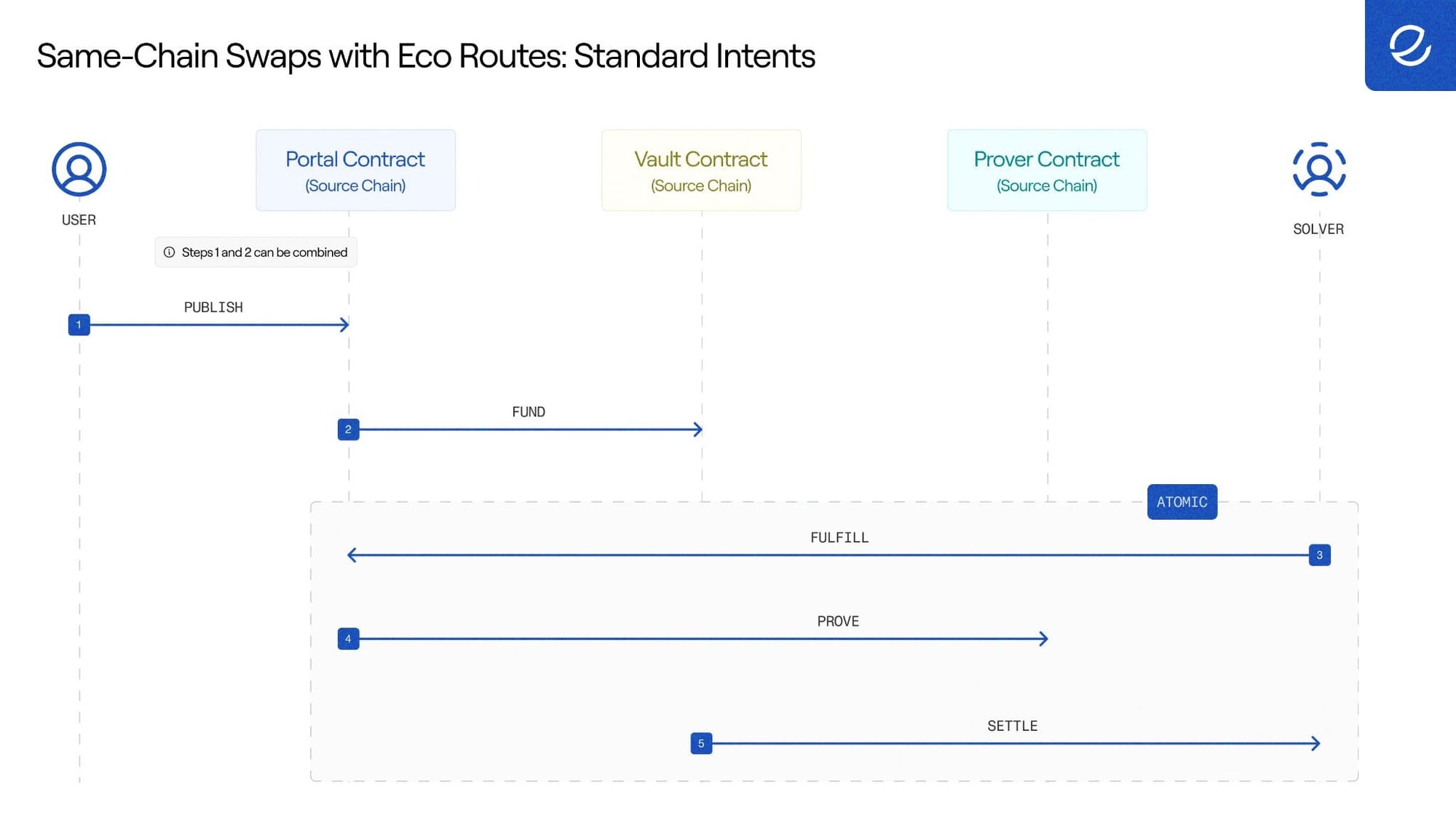
In the standard intent mode, orders only fill when solvers have sufficient liquidity. This constraint limits the network’s capacity to serve larger order sizes, an important requirement for many major companies building onchain
So what do you do when there’s insufficient liquidity, and orders need to fill fast?
Flash Intents are designed for this scenario, enabling solvers to fulfill an order atomically using the user’s capital and routing it through the lowest-cost swap pathway.
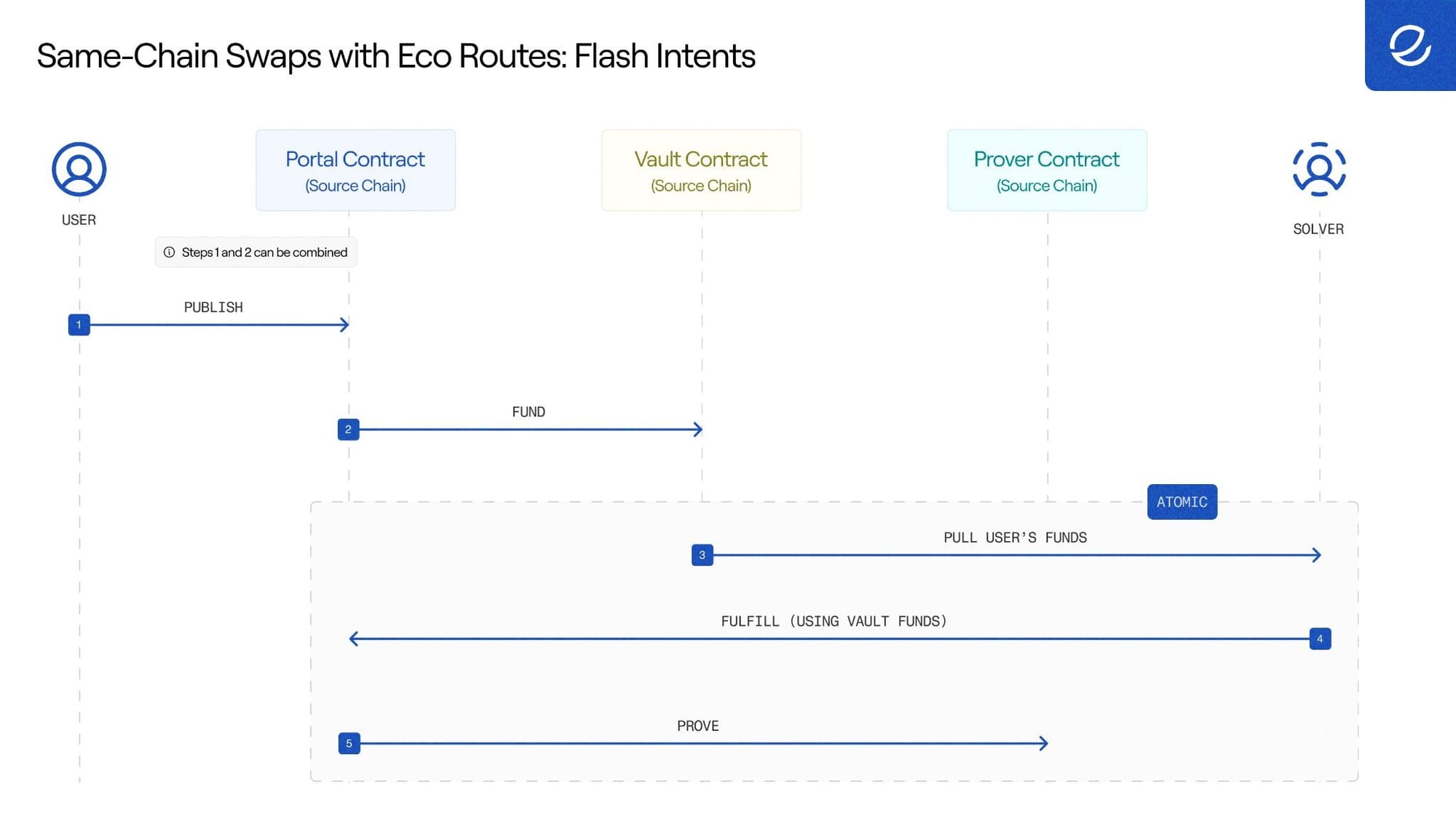
Using Flash Intents, the solver operates trustlessly on the user's own funds — simulating, splitting and orchestrating the best swap pathway, without needing to front the liquidity. This is best when no direct liquidity match exists, or when a complex path may be more efficient (again, often at larger order sizes).
Two Modes, One API for Atomic Execution
Both routing modes settle atomically. Whether a solver fronts its own liquidity (Standard) or routes through the user's funds (Flash), the swap either completes end-to-end or it doesn't happen at all — there's no partial-fill risk, and no trust assumption on the solver beyond the constraints encoded in the intent itself.
From a developer's perspective, nothing changes. Flash Intents ship as a new prover type inside Eco Routes, available through the same API surface you're already calling. Applications integrated with Routes inherit the capability automatically — no contract upgrades, no API migration, no user-facing configuration. The protocol selects the optimal mode per order based on solver competition and available pathways.
Start Building with Eco
Flash Intents are live today in Eco Routes. Applications already integrated with Routes inherit the new prover type automatically. New integrators can start with the Routes CLI and issue a same-chain intent with a single configuration change.
If you need superior stablecoin swap execution for your platform or product — across markets and assets on the same chain, or across chains — we invite you to reach out. We go deep with our partners and customers to meet stringent requirements for their stablecoin flows. We're constantly expanding and optimizing our product suite to meet customer demand. We look forward to building with you.
About Eco
Eco connects digital asset markets through stablecoins. Developers and enterprises use a single integration to program money movement across blockchains, tokenization platforms, and institutional liquidity venues, with real-time routing and pricing intelligence. Whether for trading, treasury, or payment flows, Eco delivers superior price control and all-or-nothing execution against live market conditions and customer-defined requirements.