
How Eco Routes Solves Cross-Chain’s Hardest Problem
A technical deep dive into why cross-chain execution fails at the coordination layer, and how Eco builds a better foundation.


The industry has made real progress on scaling blockchains. It has made far less progress in making them operate together as a reliable financial system.
This article argues that cross-chain payments fail first at the coordination layer, not the execution layer. The main challenge is not simply processing transactions on individual chains. It is keeping liquidity, execution, verification, and settlement aligned across fragmented systems with different constraints and failure modes. That is the point where reliability tends to break down.
Intent-based systems are the right response to that problem. By defining the outcome rather than every step, they are better suited to cross-chain environments where conditions can shift between submission and completion.
Eco Routes was built from that view. It is designed to provide applications with a better coordination and settlement foundation for cross-chain value transfer.
The Gap Between What Bridges Promise and What Users Actually Get
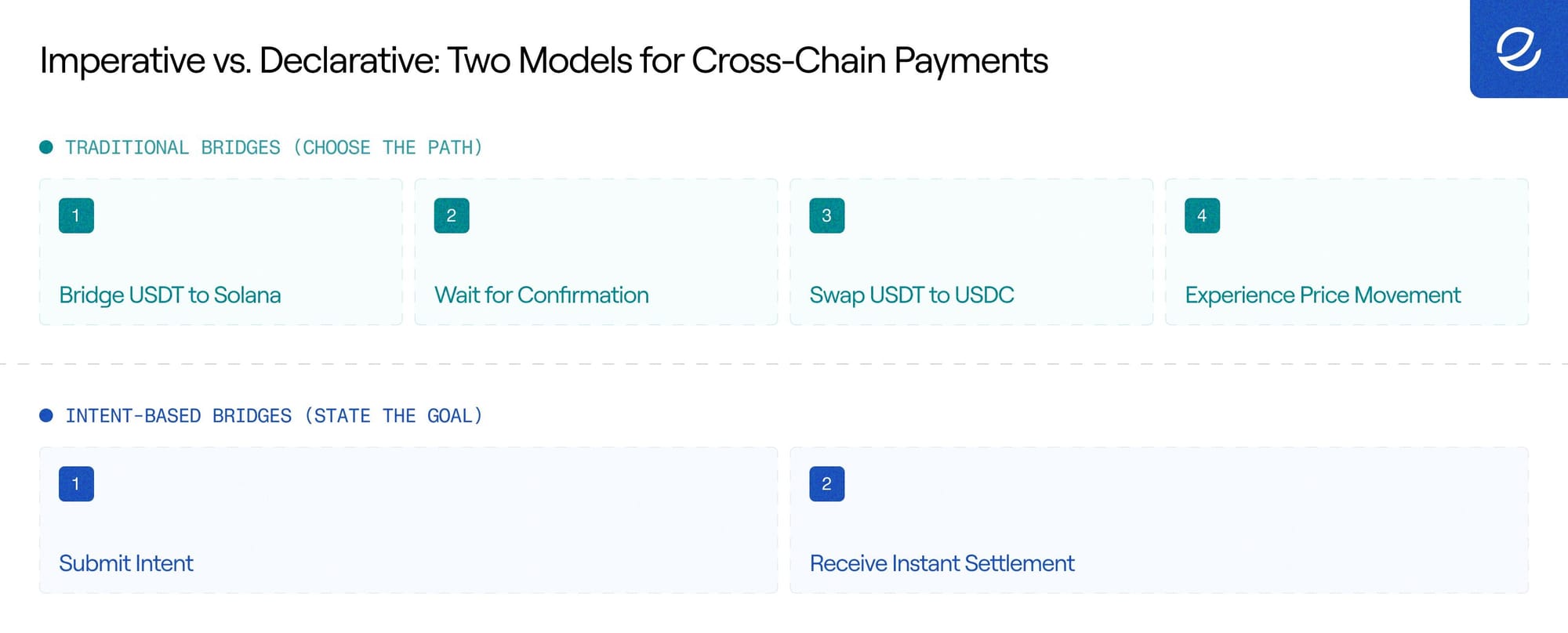
Traditional bridges follow an imperative model: users must execute a specific sequence of steps across chains — lock assets, wait for confirmations, claim funds, acquire gas, and continue execution manually. Each step introduces latency, friction, and failure risk. Too often, each step also requires the user to manually confirm.
Intent-based systems are declarative. Instead of specifying how a transaction should be performed, the user specifies the desired outcome:
“Spend 100 USDT0 from Arbitrum to and receive USDC on Base.”
Protocols handle order flow, and solvers then handle execution, delivering the result (the funds the user requested) to the destination chain, and settling (getting repaid) afterward.
A Practical Example: Why Paying an Invoice Across Chains Still Breaks
Consider a company that needs to pay a supplier in USDT on Solana while its treasury holds USDC on Ethereum.
Imperative Model (Most Bridges) Completing this payment today requires multiple manual steps across networks, assets, and gas environments, each introducing delay and potential failure. Some services wrap these actions in a single-action “policy,” but transactional execution remains inefficient underneath.
Declarative Model (Intents) Instead, the company submits a single instruction:
“Pay 100,000 USDC on Solana to this address using funds from Ethereum in USDT [with additional optional conditions as well, such as maximum slippage tolerance].”
To both sender and recipient, it feels like a single, straightforward payment, even though value might traverse multiple chains, assets, and systems before arriving.
Predictable Outcomes, Not Defined Paths
Cross-chain transfers are inherently latent. Conditions can change between submission and completion. Liquidity, pricing, gas availability, and network congestion may all shift during that window.
Imperative execution breaks when conditions change. Intent-based systems optimize for outcomes, with the best ones adapting execution at runtime and charging only for verified results.
These constraints affect real financial activity, not just technical transfers. A merchant accepting stablecoins may wait for funds to arrive while prices shift or network conditions change. A trading firm moving capital between venues risks missed opportunities if transfers stall. A payroll provider sending funds across regions cannot depend on users to manage networks or token formats. In each case, the outcome matters more than the path taken to get there.
In environments where conditions can change mid-transaction, systems must optimize for predictable outcomes rather than predefined paths.
Eco Learned This the Hard Way
Eco did not begin as a cross-chain protocol. We fought stablecoin routing problems for years while building at the app layer — first with the Eco App, the first full-featured stablecoin neobank, and then with Bend, the first account abstraction wallet purpose-built for stablecoins and global USD balances across chains. We built these products as the cross-chain environment emerged, and found ourselves constantly fighting lower-level infrastructure limitations to streamline user experience.
Delivering seamless cross-chain actions required coordinating liquidity, execution, verification, and settlement across systems never designed to work together. Eco Routes emerged from that necessity: a coordination and settlement layer that allows applications to operate across chains without rebuilding the same machinery.
How Eco Routes Solves What Other Systems Can't
Eco is a network for stablecoin orchestration across chains. Routes serves as the backbone for moving money across this network — the coordination and settlement layer for publishing intents, locking funds, verifying outcomes, and reconciling capital.
Integrators interact with a single interface, while outcomes can be delivered through multiple actors and infrastructures, including solvers and provers. This allows applications to evolve execution, verification, and trust assumptions over time without rewriting integrations.
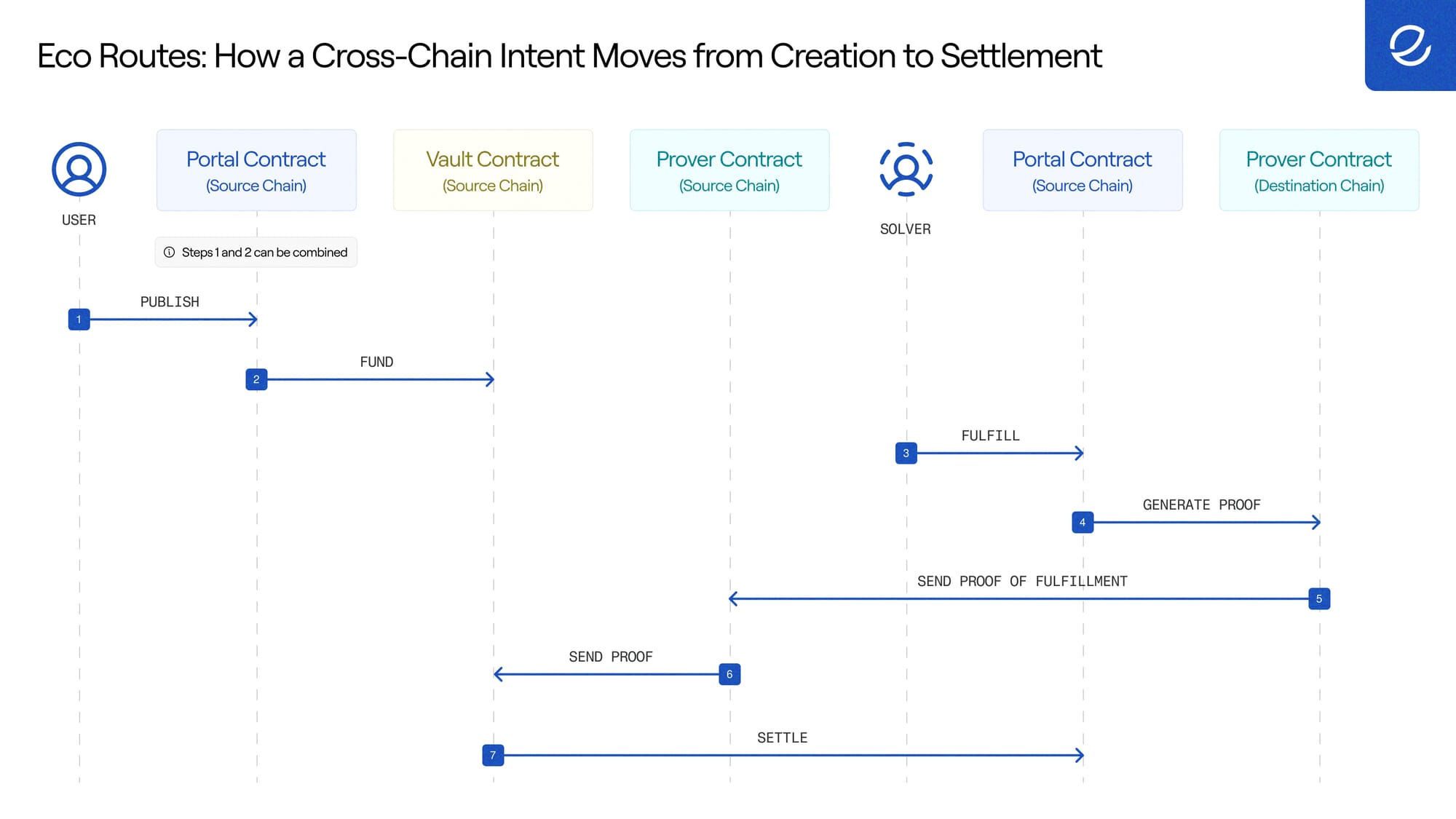
Several architectural properties enable this behavior:
The Portal: The Canonical Intent Engine
Most cross-chain systems do not operate from a single canonical state. Instead, intent creation, fulfillment, verification, and settlement are typically spread across multiple contracts, chains, relayers, and offchain services, with the final result reconciled after the fact. That architecture introduces more coordination overhead and leaves more room for duplicate execution, inconsistent outcomes, or partial completion.
The Portal contract in Eco Routes takes a different approach. It serves as the network’s canonical coordination interface, tracking each intent from creation through settlement in a single shared system of record. Because all participants reference the same state, intents can be created, extended, and fulfilled competitively without relying on a central coordinator or reconciling a fragmented state after execution.
For institutional flows, this detail is critical: it ensures more predictable execution for transactions tied to a specific outcome, such as completing a merchant payment or invoice. The Portal is non-upgradeable and trust-minimized. Once deployed, its logic is fixed, ensuring intents are executed according to their published rules.
Deterministic Vaults: One-to-One Lock for Every Intent
Cross-chain actions often require strong guarantees that funds delivered correspond to specific, defined outcomes. In Eco Routes, dedicated per-intent vaults provide that guarantee by isolating funds and preserving one-to-one tracking. Because each vault corresponds to a single intent, payments map directly to outcomes, enabling workflows such as invoices and merchant payments that require clear reconciliation rather than pooled balances.
In this system, each intent generates a dedicated vault address on the source chain that can be known in advance, even before the vault is created. This means funds can be sent to the correct destination in advance with confidence that they will settle against the intended outcome. Intent vaults are funded via simple transfer, without needing a custom integration. Vaults deploy only when needed, preserving efficiency while maintaining one-to-one settlement.
Execution That Adapts to Changing Cross-Chain Conditions
Cross-chain environments are asynchronous, and conditions can change between submission and completion. Systems that rely on fixed transaction paths become fragile when liquidity, pricing, or network conditions shift.
By expressing actions as outcomes rather than steps, Routes allows execution to adapt to available liquidity, pricing, and network conditions as solvers adjust their execution strategies. But Routes goes further still, with runtime routing and solver strategies to ensure price performance and capital efficiency reflect real-time market conditions. From the user's perspective, the interaction remains a single action even as the protocol adjusts internally.
Verification and Settlement Without Single-Point Failure
Releasing funds safely requires verifying that the promised outcome actually occurred. Systems that depend on a single verification mechanism inherit its speed, cost structure, throughput, and availability constraints. When that pathway degrades, settlement degrades with it.
Routes support multiple independent verification paths, allowing settlement to proceed through the method that best fits the transaction’s requirements. For example, verification may occur through
Chainlink Labs CCIP, Hyperlane (Abacus Works), LayerZero Labs messaging, Polymer Labs proving, or Eco’s Local Prover for same-chain intents. New methods will be added in the future, as well as the ability to rely on multiple designated methods if desired.
Applications are also not locked into a single operating model. They can allow open competition and let price and speed determine who fulfills an intent, or they can restrict participation to approved solvers based on reliability, commercial terms, liquidity availability, or compliance requirements.
This flexibility prevents the system from being tightly coupled to any single bridge, relayer set, proving mechanism, or participation model. It also allows verification methods and fulfillment requirements to evolve over time without forcing integrators to rewrite their integrations. Diversified verification reduces correlated downtime risk and allows settlement characteristics to match the transaction profile. High-value transfers may prioritize stronger guarantees and tighter participation requirements, while everyday payments may optimize for cost, speed, and broader solver competition
Beyond Simple Transfers: Settlement and Orchestration
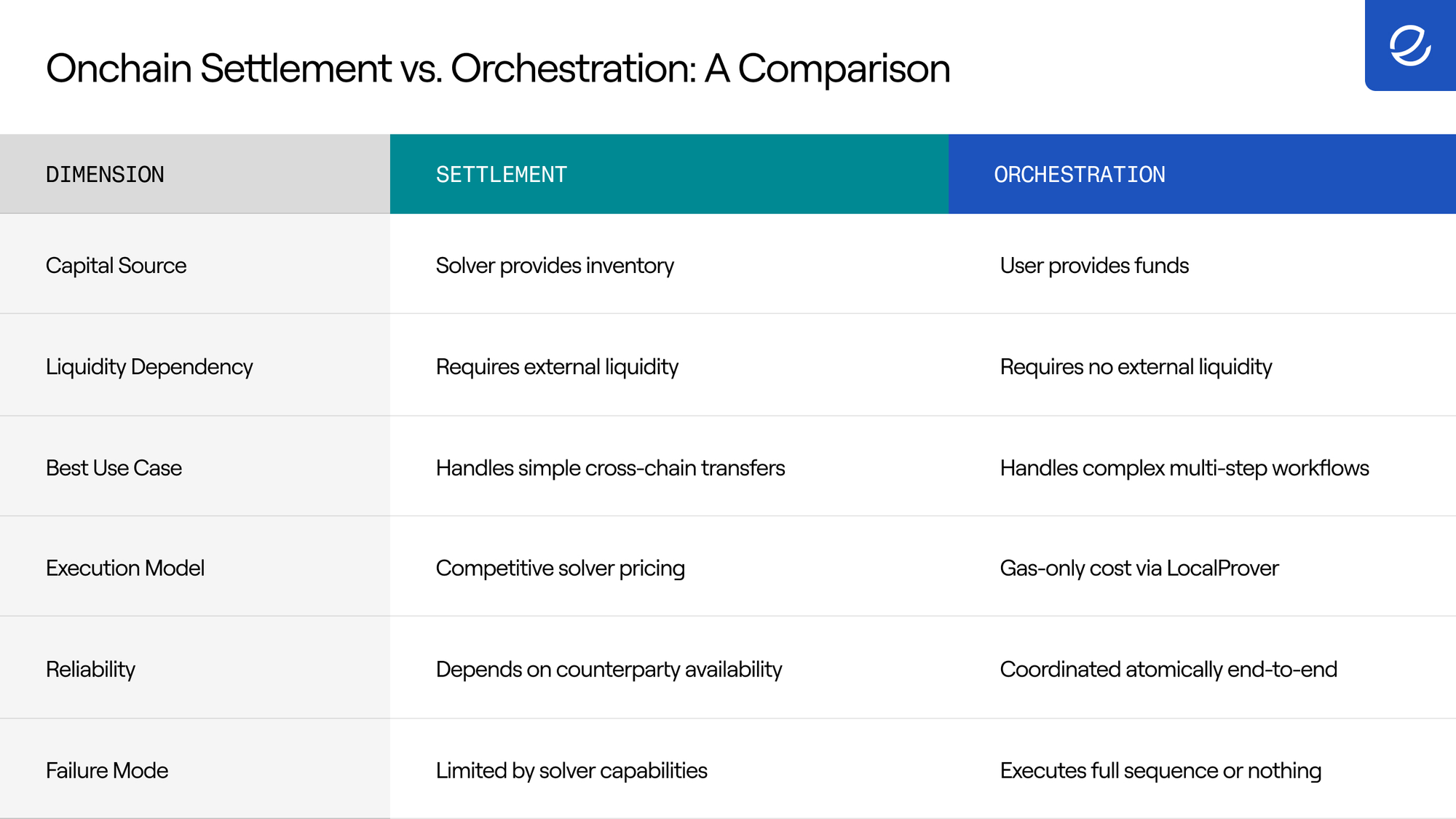
Eco supports two models for cross-chain execution: settlement and orchestration. Most intent systems focus on settlement, in which a solver provides the liquidity needed to deliver the result. This works well for simple transfers, but it still depends on solver capital being available and efficiently positioned to complete the flow. Our capital efficiency requirements and sensitivity to market conditions are heightened by our focus on stablecoins, where even a single basis point of slippage can affect execution quality.
Orchestration expands what the system can do. Instead of relying solely on solver-supplied liquidity, the user’s own funds can flow through the underlying infrastructure to complete the full action. This is valuable when the goal is not just moving assets, but achieving a conditional outcome. For an individual, that could mean moving funds cross-chain, converting them to the appropriate stablecoin, and funding an app in a single, coordinated flow. For a business, it could mean reallocating treasury across chains and currencies, then completing payroll or supplier settlement as part of the same process.
These more complex orchestration flows are where Eco’s routing really shines. Routes can use solver-based settlement when that is the right path, but it can also coordinate direct execution when that is the better path. That flexibility allows Eco to support broader cross-chain financial actions, not just simple transfer fulfillment.
A Foundation for Smarter Money Movement
Eco Routes is the base layer for Eco’s orchestration network. Moving money across chains is rarely just a simple transfer. It often involves multiple dependencies, execution environments and infrastructure choices that need to work together reliably. Instead of forcing users and developers to manage these choices, Eco Routes abstracts the complexity and turns cross-chain actions into a single coordinated process.
With execution guarantees and an extremely high degree of programmability and control, developers can support increasingly sophisticated financial products and flows. The end state is not multichain complexity. It is one coordinated financial system.
About Eco
Eco connects digital asset markets through stablecoins. Developers and enterprises use a single integration to program money movement across blockchains, tokenization platforms, and institutional liquidity venues, with real-time routing and pricing intelligence. Whether for trading, treasury, or payment flows, Eco delivers superior price control and all-or-nothing execution against live market conditions and customer-defined requirements.