
Programmable Addresses V2: Automate and Simplify Deposits and Withdrawal Flows, with Single-Click UX.
Eco Programmable Addresses now enable persistent or single-use deposit addresses, and any-asset input.

Enabling crypto deposits and payouts comes with significant complexity for product builders operating cross-chain, cross-asset flows. You need infrastructure to listen for chain events and recognize transfer requests, figure out how to route them, construct the transaction, cover the gas, and reconcile it all in the end. Eco Programmable Addresses replace all that work with a single API integration and a single transfer for your users. Funds arrive, your logic runs, and you get your specified outcome.
Until now, Programmable Addresses V1 enabled a fixed-fee, deterministic address that ran a preset action. Today, we’re releasing V2 for one-time, per-transaction use with a live price quote. You can now pick the best solution for your product.
Read on below to understand how V1 and V2 compare with other deposit address offerings in the market—and which one is best suited for your use case.
What's New in Programmable Addresses V2
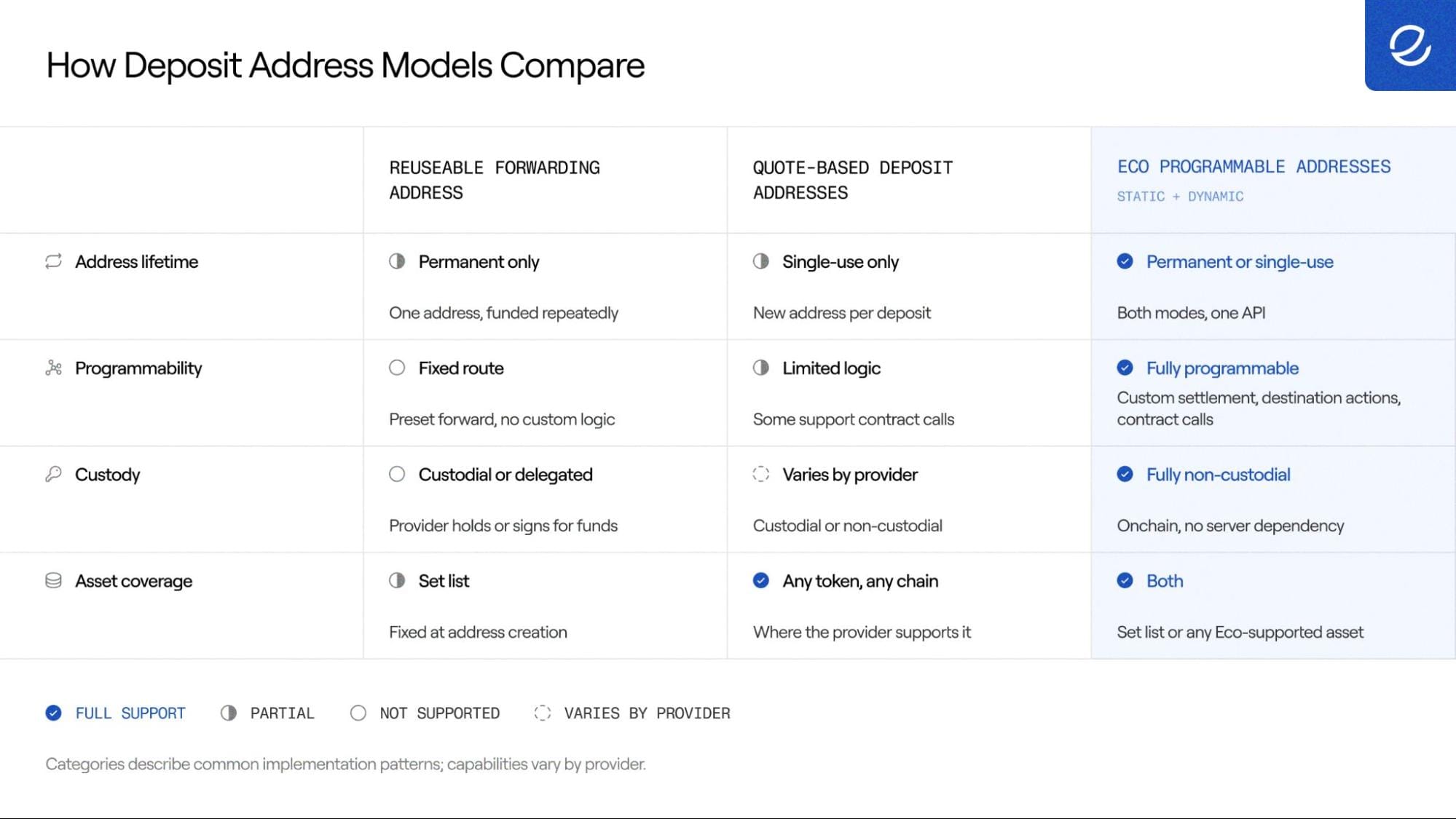
Static (V1) addresses are unchanged: They enable one permanent address, one pre-set action, with a flat-rate price, funded as many times as you like. But this comes with certain trade-offs for what assets you can process and what actions you can take.
Dynamic (V2) addresses are single-use addresses that prioritize flexibility over persistence:
Best real-time execution on every deposit. A V2 address is priced dynamically, ensuring best price execution across Eco's solvers, issuer lanes, and venues. Your user sees the cost before any funds move, and it reflects the best route available at that moment.
Any Eco-supported asset. A static address is bound to a list of input tokens at creation and has to be extended manually. A dynamic address processes any Eco-supported asset automatically.
Exact attribution. You request an address, pass the amount, and get back a dedicated vault with a quote and a deadline. One address maps to exactly one deposit, so reconciliation is exact by construction. No shared-address guesswork, no manual matching.
Gasless funding with automatic failover. You can fund the vault with a normal ERC-20 transfer or gaslessly with ERC-3009, and the transaction settles accordingly.
Transaction logic and market composability. A V2 address is not a forwarding hop. It is an Eco Routes intent with your rules for it:
- Price controls: slippage bounds, minimum out, deadline, and which prover settles it
- Destination actions: land the deposit as a different asset, on a different chain, into a contract
- Withdrawals on the same rails: pay out to any chain without a per-chain integration for each one
- Constraints from your own policy engine, consumed and executed for higher-stakes flows
The result: Transactions settle in seconds, and your integration inherits new chains and assets with gasless functionality as Eco supports them, with no new work on your side.
Initially, V2 addresses come with prebuilt action types. Soon, they will enable arbitrary composed actions, with several steps stitched into one atomic transaction behind a single address.
How Deposit Address Models Compare
Build Your Flow
Here are some ways partners use Programmable Addresses today:
Account funding from anywhere. A user funds their account on your platform from whatever chain and whatever stablecoin they already hold. You show them the exact amount they will be credited before they send, and the deposit lands in the asset your ledger is denominated in. Replaces a bridge UI, a chain watcher, and a reconciliation job with one API call and a transfer.
Per-invoice and per-order settlement. One address per invoice, carrying the quoted amount and a deadline. The payment either settles at the figure you quoted or refunds itself. No shared address to disambiguate later, no partial payments to chase, and the credit reconciles against the quote that produced it.
Receiving across virtual machines. Give a user who only has a Solana wallet an EVM address that senders can pay normally. Funds arrive on Solana. No second wallet to create, no network to switch, no bridge for either side to learn.
Accept any stablecoin, settle to one. Take deposits in whatever your counterparties hold and consolidate to the stablecoin your treasury actually runs on, with a per-transfer record you can export. The conversion is part of the deposit rather than a second job you run afterward.
Payouts on the same rails. Send to any chain Eco supports without standing up a per-chain integration for each one, using the same quoting and settlement guarantees as the inbound side.
Recurring flows behind a permanent address. One address per user, per product surface, or per subscription, running the same action every time it is funded. No API call per deposit, no quote to refresh, no expiry to handle. Hand it out once, and it keeps working.
In every case, it’s the address and Eco’s routing doing the work, not your backend. You don’t need to build event listeners, error monitoring, retry logic, gas management, or routing. That’s what we take care of, so you can focus on building the best product.
Programmable Addresses are live in production today. Read the Programmable Addresses docs to integrate, and contact us if you need support for your flow.
About Eco
Eco connects digital asset markets through stablecoins. Developers and enterprises use a single integration to program money movement across blockchains, tokenization platforms, and institutional liquidity venues, with real-time routing and pricing intelligence. Whether for trading, treasury, or payment flows, Eco delivers superior price control and all-or-nothing execution against live market conditions and customer-defined requirements.