
Why $32 Trillion in Stablecoin Volume Still Can’t Beat Fintech
Stablecoins have the speed. They have the volume. What they don't have is the one thing institutions actually care about.


Stablecoins settled $32 trillion in 2024 (Source: Visa), and the total stablecoin market capitalization is projected to hit $3 trillion by 2028 (Source: Bernstein Research). That growth isn't coming from DeFi power users. It's coming from institutions that expect the same execution guarantees they get from Wise, from SWIFT, from Visa.
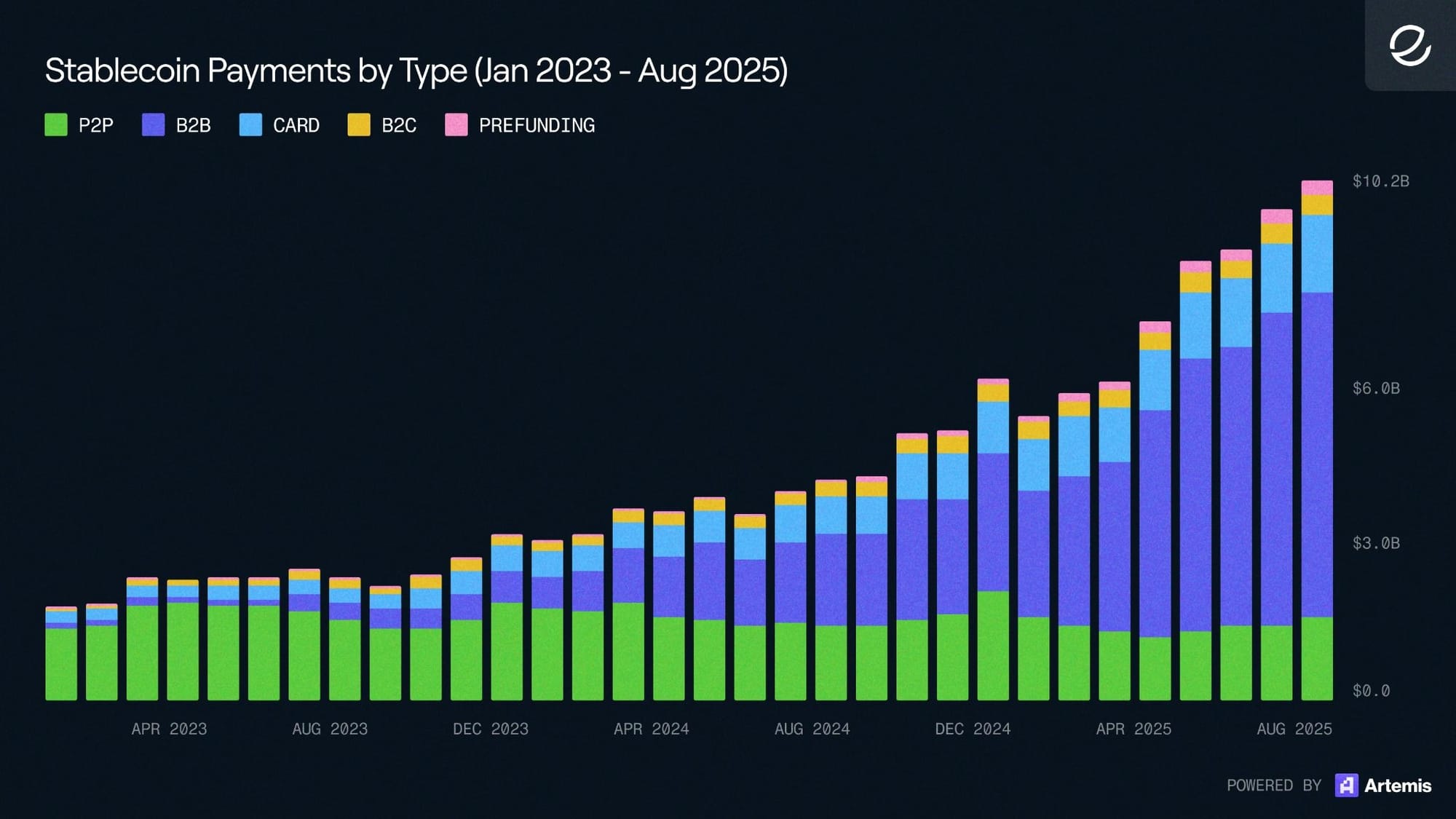
The infrastructure is scaling. The technology works. But, there's still an underestimated market inefficiency that will hinder institutions until someone fixes it: crypto's execution model is incompatible with the high demands of modern-day payment systems.
In crypto, cross-chain capital movement is often subject to quote-and-fill mechanics. A quote is the bridge’s estimated output, fees, and timing before you transact, while the fill is the actual execution and delivery of funds on the destination chain. The price between those two moments is a problem. In payments, it's unacceptable.
In this post, we’ll discuss the impact of quote-and-fill mechanics, their mismatch with institutional expectations, and how we can rearchitect onchain money movement to unlock the next wave of institutional adoption.
Why Quote-and-Fill Doesn’t Work in Enterprise Payments
Stablecoins have empowered anyone with an internet connection to gain exposure to the US dollar through crypto-native rails. Venues ranging from decentralized stablecoin pools to OTC desks now facilitate trillions of dollars in annual volume, with institutional OTC stablecoin activity alone surging 147% year-over-year in 2024 (Source: Finery Markets). Despite that traction, the quote-and-fill model that underpins stablecoin execution — whether through market maker RFQ desks or onchain AMMs — does not yet demonstrate the pricing consistency or predictability demanded by mature market participants (e.g., PSPs).
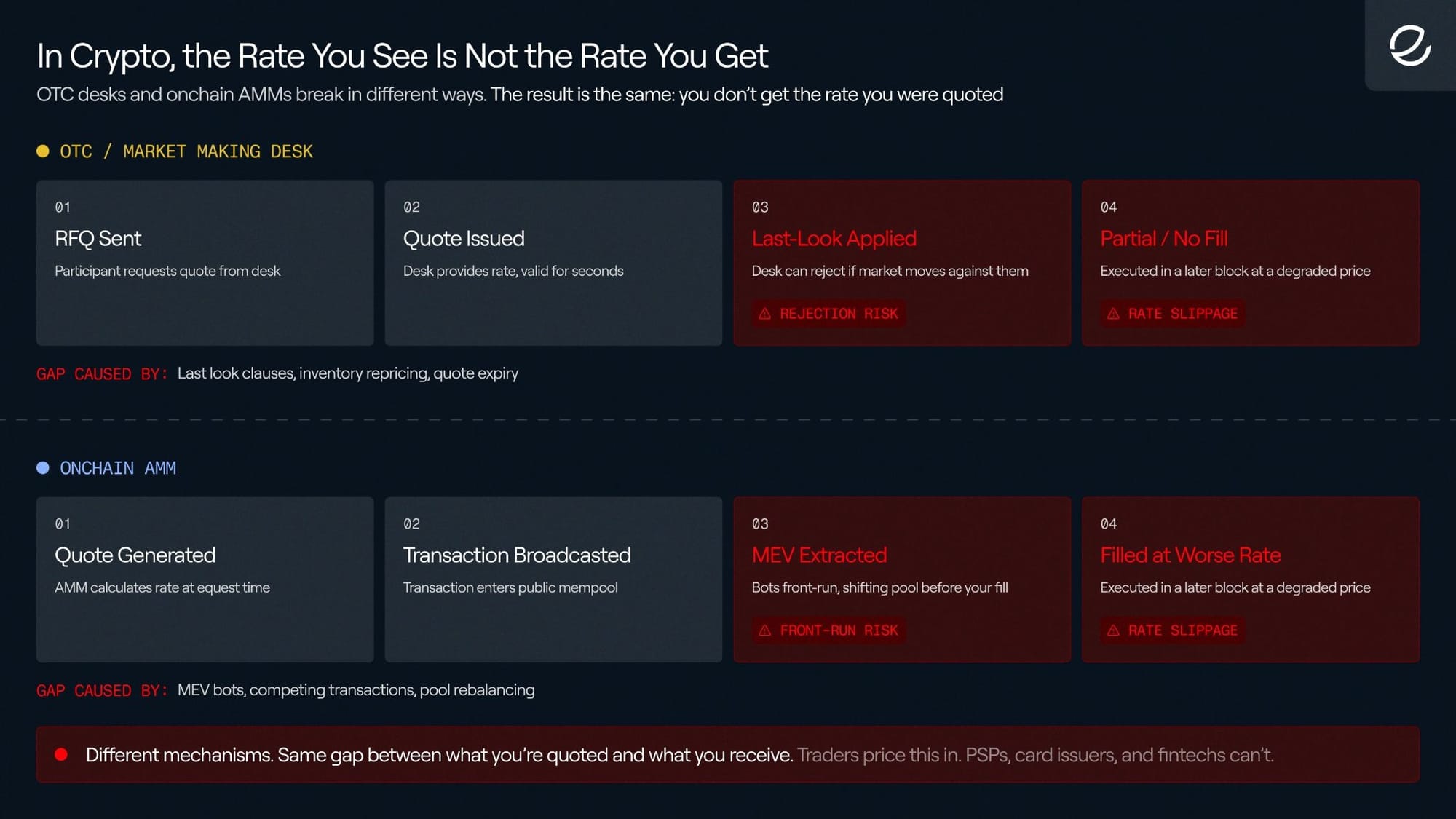
Quote-and-fill failure in stablecoin markets is structural, not incidental. When a participant requests a quote to convert or settle into stablecoins, the rate they see reflects a snapshot of liquidity at that moment. By the time a fill is sought, those conditions have often changed. Stablecoin pools reprice in real time based on pool composition; OTC desks reprice based on inventory exposure. Neither venue treats the quoted rate as a commitment. Quote data grows stale amidst market volatility, liquidity that appears executable at the quoted price disappears once orders interact, and fill rates degrade.
On OTC desks, last-look clauses allow a market maker to reject a stablecoin conversion if the market moves before fill, leaving the counterparty with no execution and an expired quote. Onchain, AMM pricing is calculated at quote time but fills in a future block — by which point MEV bots, competing transactions, and pool rebalancing have already shifted the rate. The arrival price and fill price routinely diverge (Source: Talos), with shortfalls concentrated during high-volatility periods when guaranteed execution matters most.
This may be acceptable for traders who understand quote latency, last-look mechanics, and the probabilistic nature of fill. They model it in.
But stablecoin payments aren't trades. They are settlement mechanisms used by a broad range of participants — from individuals sending remittances to enterprises settling cross-border obligations — none of whom can absorb an unpredictable gap between the rate they were shown and the rate they received.
Legacy Infrastructure Fixed This. Crypto Hasn't.
Legacy payment systems solved for execution uncertainty decades ago because they had to. You can't build commerce or mature cross-border transfers on "your price may vary" disclaimers. Otherwise, you simply don't attract customers.
Take Wise, one of the leading payment companies moving hundreds of billions of dollars annually, and built a massive business on one insight: guaranteed execution matters more than quoted estimates.
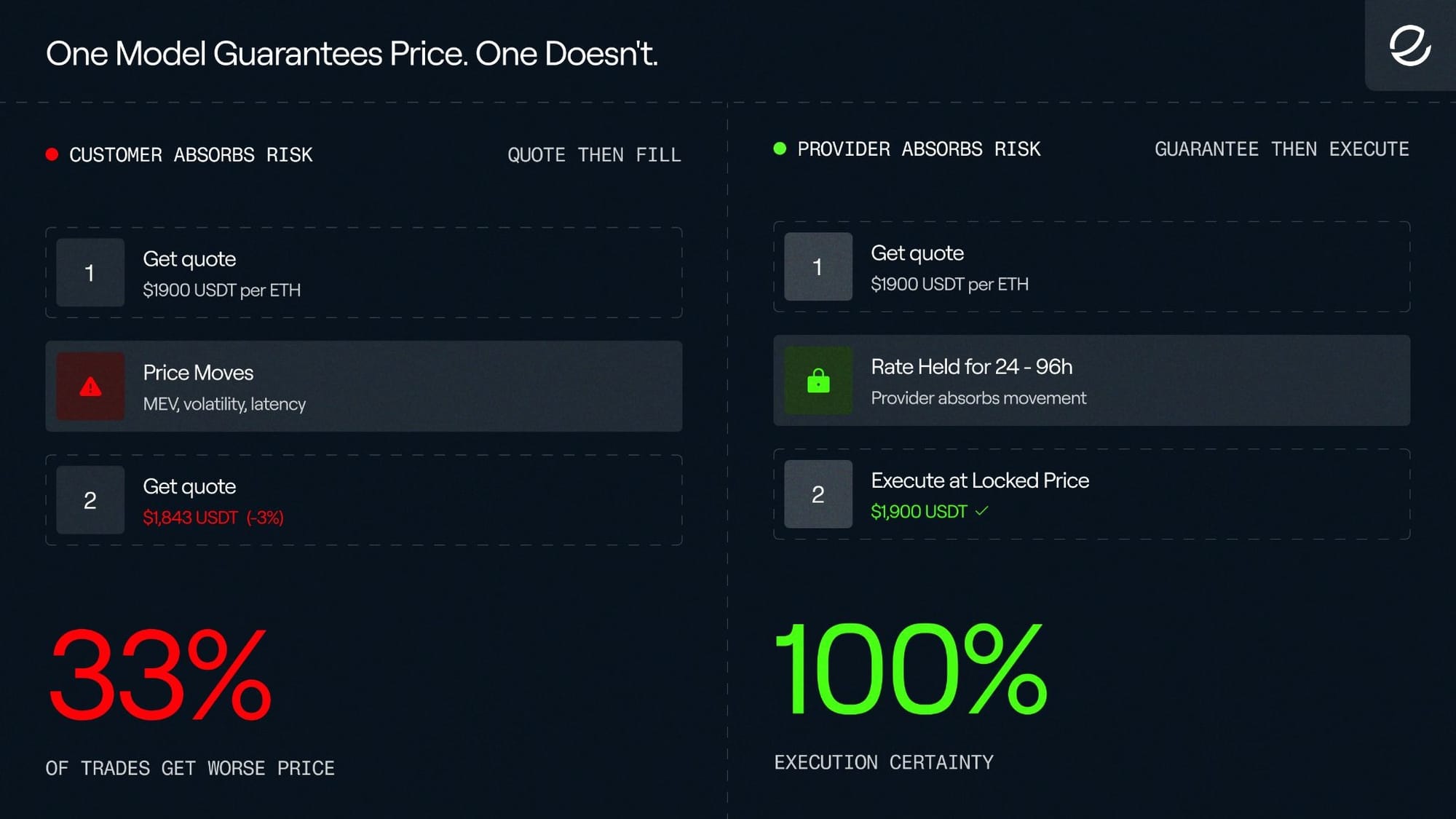
Their model: rate locked for 24-96 hours upon receipt of funds. If markets move more than 5%, the transfer is cancelled and refunded. The customer sees exactly what the recipient gets before committing funds.
The result? ~$149 billion (£118.5B) in cross-border volume for FY2024, with an average fee of 0.62%. Profit before tax tripled year-over-year to ~$606 million (£481M). And most importantly, 12.8 million customers are moving over $12 billion monthly. (Source: Wise).
Wise doesn't quote-and-fill. They guarantee-then-execute. That's the key difference.
The Hidden Tax in Stablecoins
Since stables came onchain, they've grown rapidly, exceeding $300 billion in total circulating supply. Stablecoins promise an experience much more efficient than the current technologies surrounding money, and above all, the core pitch is speed: "Blockchain settles in under 3 minutes versus 3-5 days for SWIFT!"
True. But speed without execution certainty is just faster uncertainty.
The on-ramp introduces slippage. The off-ramp introduces more slippage. By the time you've converted fiat to stablecoins, transferred them, and converted back to local fiat, your total cost can exceed a wire transfer.
The Bank for International Settlements found that cross-border settlement via correspondent banking ranges from "less than five minutes to more than two days." Blockchain's speed advantage only materializes if the execution price is guaranteed. Otherwise, you're just losing money faster.
People often don’t realize that the onchain stableswap market is its own sort of forex market today. There is typically a small spread between stablecoins on each chain. When transaction routers do not effectively control for this, end users experience unexpected slippage on their funds — something stablecoin use cases are way more sensitive to.
For the stablecoin market to meet demand, we must think about stablecoin routing and liquidity through a similar lens to Wise's approach to forex: quoting for execution guarantee, not target ranges.
Without Execution Certainty, Speed Is Worthless
The next generation of stablecoin users won't be deeply well-versed in crypto products by default. These "users" are not individuals at all; they're among the world's largest organizations.
They're payment service providers (PSPs), fintech companies, debit and credit card issuers, B2B treasury teams, and more.
These aren't users who will "set slippage to 2%, and hope for the best." They have actual business requirements. They require and demand absolute certainty. And without certainty, critical problems arise:
- PSPs quote merchants a fixed take rate. If underlying execution costs are variable, the PSP either eats unpredictable margin compression or passes uncertainty to merchants. Neither works at scale. A processor can't tell Shopify, "your payout might be 1.2% or 2.8% depending on market conditions."
- Fintech companies building on stablecoin rails need consistent pricing for regulators. "Market conditions vary" isn't an acceptable answer for customers when you're a licensed organization. Try explaining slippage tolerance to the FCA.
- Debit and credit card issuers need precision to the basis point. Visa is already piloting USDC settlement on Solana. A 0.5% slippage swing obliterates interchange economics. Typically, merchants eat the variable costs of card transactions, making the quote-and-fill model of onchain execution off-putting.
- B2B treasury teams moving $500K between subsidiaries won't want to explain to the CFO why Tuesday's transfer cost 1.2% and Thursday's cost 2.8%.
What Stablecoin Infrastructure Must Get Right to Win
For crypto rails to actually compete and surpass the capabilities of legacy payments infrastructure, the industry needs predictable, guaranteed execution — meaning the price you see is the price you get, full stop, with any market movement between quote and settlement absorbed by the infrastructure provider, not passed on to the customer.
Circle's cross-border solution is moving in this direction with 24/7 settlement and real-time visibility. Some of the newer stable-to-fiat corridors are getting closer. But the default across most crypto payment infrastructure is still hope-based pricing.
As the B2B and wholesale stablecoin market scales to meet payments demand, guaranteed onchain execution will become non-negotiable. The firms that figure out guaranteed execution on stablecoin rails will capture the next decade of payments. At Eco, this is one of our core priorities. Eco’s architecture provides the necessary infrastructure to deliver guaranteed execution of stablecoin rails at scale, absorbing settlement risk at the infrastructure layer so businesses can transact with the same pricing certainty they expect from legacy payment networks. If you’re building an onchain solution that requires superior, guaranteed stablecoin execution, Eco can help.
About Eco
Eco is the stablecoin network that makes money programmable across every major blockchain. Developers use Eco to power stablecoin flows that require seamless user experience and best-in-class execution — cross-chain transfers and swaps, programmable account logic, fast deposits, and more complex automations. Money simply moves smarter with Eco.
Website | Eco Docs | Twitter | LinkedIn | YouTube
About Eco Inc.
Eco Inc. builds technology that powers smarter, real-time money movement using stablecoins. We expect better from our money. That’s what drives us every day.